The Ultimate Guide: Jawline Before and After Braces Face Shape
The truth about orthodontic treatment goes far beyond straight teeth. Discover the incredible science of how fixing an overbite, resolving an underbite, and aligning your bite can dramatically transform your jawline and redefine your entire face shape.
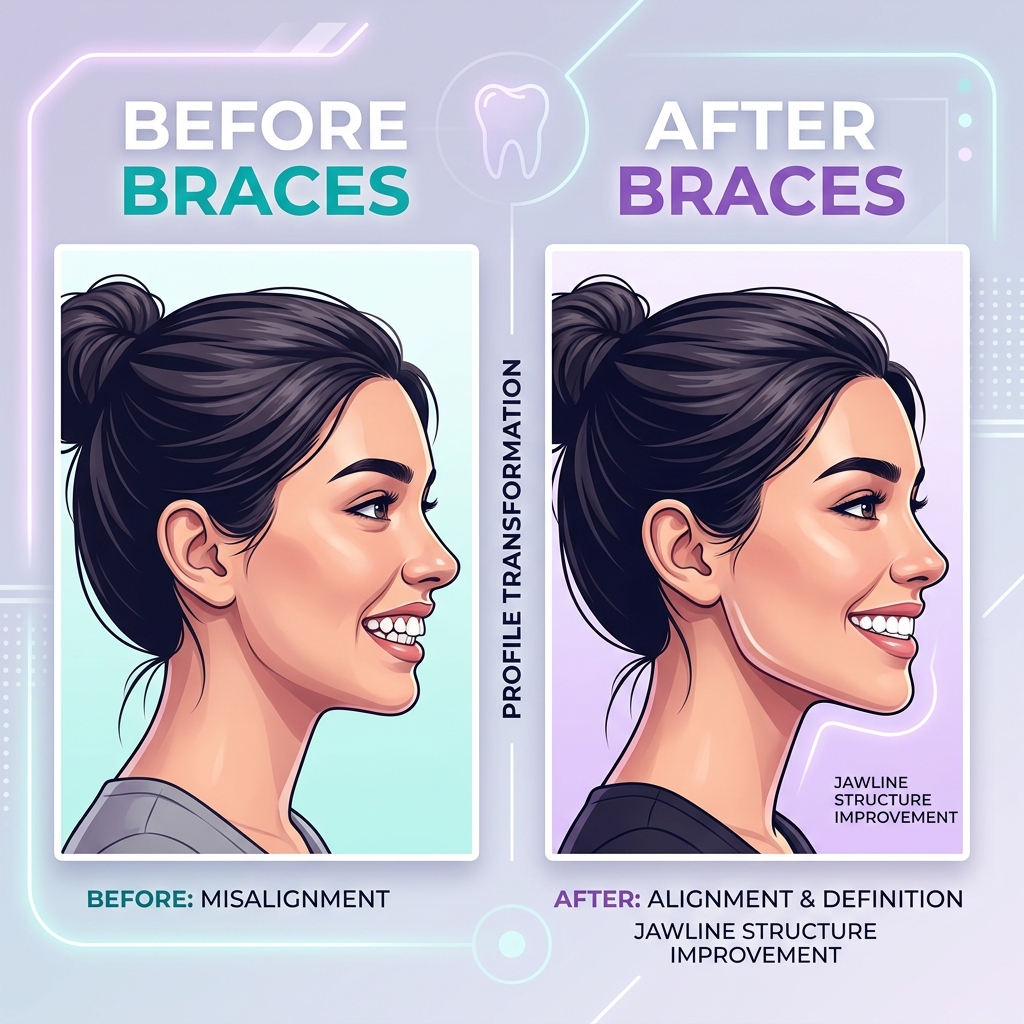
How braces can bring a recessed jawline forward for a stronger silhouette
Before Braces
Recessed lower jaw, weak profile.
➔
After Braces
Aligned bite, stronger jawline definition.
When most people think of braces, they envision a perfectly straight, dazzling set of teeth. However, the true magic of orthodontic treatment lies beneath the gums. By manipulating the roots of your teeth and altering the way your upper and lower teeth lock together, orthodontics can fundamentally change the resting posture of your facial muscles and alter your soft tissue profile. Understanding the transformation of the jawline before and after braces face shape is crucial for anyone considering treatment for both functional and aesthetic reasons.
The Science: Muscles, Bones, and Teeth
To understand how braces change your face shape, we must look at the anatomy of the skull. Your teeth are embedded in the maxilla (the upper jaw bone) and the mandible (the lower jaw bone). These bones support the soft tissues of your face—your lips, cheeks, and chin.
When you have a malocclusion (a bad bite), your teeth do not fit together properly. This forces the muscles of your face, specifically the masseter muscles around your jawline, to overcompensate or rest in an unnatural position. When orthodontic treatment moves the teeth into perfect alignment, the way your jaws close changes completely. This shift in the bite alters the draping of the skin and muscles over your bone structure, directly impacting your facial proportions.
📐
The Golden Rule of Orthodontic Aesthetics:Braces do not literally shave down or build new bone in adults. Instead, they change the resting posture of your jaws and the support structure behind your lips and cheeks. This shift in posture is what creates the dramatic change in your visible jawline.
Overbite Correction: Strengthening the Lower Jaw
An overbite occurs when the upper front teeth significantly overlap the lower front teeth. In severe cases, the lower jaw is forced backward toward the neck, resulting in what is commonly called a "recessed chin" or a "weak jawline."
The Transformation:
When an orthodontist corrects a severe overbite using metal braces, elastics (rubber bands), or specialized appliances like a Herbst appliance, the goal is to bring the lower jaw forward into its proper alignment with the upper jaw.
As the lower jaw moves forward, several incredible aesthetic changes occur. First, the chin becomes more prominent, creating a stronger side profile. Second, bringing the jaw forward naturally tightens the skin and muscles directly underneath the chin. This often drastically reduces the appearance of a "double chin" and creates a much sharper, highly defined jawline. Patients who undergo overbite correction often experience the most dramatic, positive face shape transformations.
Underbite Correction: Softening the Chin
An underbite is the exact opposite; the lower front teeth protrude past the upper front teeth. This often gives the patient a prominent, jutting "bulldog" chin and a lower jaw that appears disproportionately large or aggressive.
The Transformation:
Treating an underbite involves bringing the upper teeth forward and shifting the lower teeth backward. In cases of mild to moderate underbites, braces and elastics adjust the angle of the teeth to correct the bite. By pulling the resting position of the lower jaw back, the sharp, jutting appearance of the chin is softened.
This creates an incredibly harmonious transformation. The face looks less bottom-heavy, restoring natural facial symmetry. For severe, skeletal underbites, orthodontic treatment is often combined with orthognathic (jaw) surgery to physically reposition the mandible, which profoundly alters and softens the jawline.
Crossbite & Open Bite: Restoring Facial Symmetry
Not all bite issues only affect the side profile. Crossbites and open bites can severely impact how your face looks from the front.
The Crossbite:
A crossbite happens when some of your upper teeth sit inside your lower teeth when you bite down. To compensate for this uneven bite, patients often chew predominantly on one side of their mouth. Over years, this asymmetric chewing builds up the masseter (jaw) muscle on one side, leading to a visibly lopsided or crooked jawline. Correcting the crossbite with braces allows the muscles to relax and work evenly, slowly restoring beautifully balanced facial symmetry.
The Open Bite:
An open bite occurs when the back teeth touch, but the front teeth do not close together. This often forces patients to stretch their lips to close their mouth, making the face look abnormally long and straining the facial muscles. Closing an open bite with orthodontic treatment relaxes the lips and can make an elongated face shape appear more proportional and relaxed.
The Role of Palate Expanders and Cheekbones
In many cases, an overbite or crossbite is caused by a narrow upper palate (the roof of the mouth). Before or during the application of braces, an orthodontist may use a palate expander.
Widening the Face:
A palate expander physically widens the upper jaw bone. While the primary goal is to create room for crowded teeth, the aesthetic side effects are phenomenal. Widening the upper jaw provides broader support for the cheeks. Patients often notice that their cheekbones look slightly more lifted and prominent after expansion. Furthermore, it creates a wider, broader "Hollywood" smile that fills the corners of the mouth.
Tooth Extraction: The "Sunken In" Myth
One of the biggest fears surrounding orthodontic treatment is that having teeth pulled will ruin your face shape. You may have read horror stories online claiming that tooth extraction for braces causes the face to look "sunken," ages the patient prematurely, or ruins a strong jawline.
The Reality:
In decades past, pulling premolars was a standard protocol for almost all crowding cases. If teeth are extracted unnecessarily and the remaining teeth are pulled too far back, it can indeed reduce the support for the lips, causing them to thin out, and slightly flattening the profile. However, modern orthodontics avoids tooth extraction whenever possible, utilizing clear aligners, expanders, and modern bracket technology to create space.
When extractions *are* performed today, they are meticulously calculated. In cases of severe protrusion (where the teeth stick out so far that the lips cannot close naturally), extracting teeth and pulling the front teeth back actually *improves* the face shape by allowing the lips to rest naturally and creating a more elegant, balanced profile.
The Age Factor: Adults vs. Growing Teens
It is vital to understand that the degree to which your face shape changes depends heavily on your age.
Growing Teens (Ages 7-15):
In adolescents, the facial bones are still soft, growing, and fusing. Orthodontists can use specialized appliances (like headgear, Herbst appliances, and expanders) to literally guide and alter the growth of the jawbones. They can hold the upper jaw back while encouraging the lower jaw to grow forward, resulting in massive, permanent structural changes to the bone structure and jawline.
Adult Orthodontics:
In adults, the bones have fully hardened and fused. Metal braces or clear aligners will not grow new bone or change the physical length of your mandible. The changes you see in an adult jawline before and after braces face shape are strictly due to the teeth moving into new positions, which changes how the jaws rest together and alters the drape of the soft tissues (muscles, skin, lips) over the existing bone.
The Orthodontic Face Shape Cheat Sheet
Bite Issue
Orthodontic Correction
Aesthetic Effect on Face Shape & Jawline
Severe Overbite
Brings lower jaw forward to align with top teeth.
Sharpens the jawline, reduces "double chin" appearance, creates a stronger side profile.
Severe Underbite
Brings upper jaw forward / pulls lower jaw back.
Softens a protruding, aggressive chin. Restores harmony to bottom-heavy facial proportions.
Crossbite
Aligns upper and lower arches correctly.
Fixes asymmetrical chewing, which reduces lopsided jaw muscles and restores facial symmetry.
Open Bite
Closes the gap between upper and lower front teeth.
Relaxes strained lip muscles, making a long, stretched face shape appear more relaxed and proportional.
Narrow Palate
Uses a palate expander to widen the upper jaw.
Provides more structural support to the mid-face, often resulting in slightly more prominent cheekbones and a wider smile.
Severe Protrusion
Requires tooth extraction to pull teeth backward.
Allows strained lips to close naturally. Softens a bulky, protruding mouth area into an elegant profile.
Conclusion: A Structural Masterpiece
The transformation of your jawline before and after braces face shape is one of the most remarkable benefits of orthodontic treatment. You are not just investing in straight teeth; you are investing in the architectural foundation of your face. By correcting an overbite, resolving an underbite, and ensuring your bite locks together with perfect facial symmetry, orthodontics optimizes the resting posture of your muscles and skin.
Whether you choose traditional metal braces or modern clear aligners, the functional correction of your bite will inevitably lead to a more balanced, harmonious, and confident aesthetic. Consult with a board-certified orthodontist to understand exactly how aligning your unique bone structure can elevate your profile.
Frequently Asked Questions
10 FAQs
If you have an overbite or a recessed chin, yes! By correcting the bite, the lower jaw rests further forward. This naturally tightens the soft tissue under the chin, which often results in a significantly sharper, more defined jawline profile.
Yes. The appliance used (whether it is clear aligners or traditional brackets) is just the tool used to move the teeth. If an orthodontist uses aligners to successfully correct a severe bite issue (like an underbite), the resulting changes to your facial proportions will be the same.
Many patients experience the "braces diet." Because your teeth are sore, especially in the first few months, you may eat less or switch to softer foods, leading to minor weight loss that thins the face. Additionally, changes to the chewing muscles can reduce facial bulk, making the face shape appear slimmer.
Yes, significantly. Your teeth provide the direct structural scaffolding for your lips. If your front teeth are pushed forward, your lips will look fuller. If flared front teeth are pulled backward, your lips will lay flatter against your face, which alters your soft tissue profile.
This is a major fear, but usually unfounded. If tooth extraction is improperly diagnosed, pulling teeth back too far can create a flattened, "sunken" profile. However, modern orthodontists are highly trained to avoid this, only using extractions when necessary to fix severe protrusions or extreme crowding.
In adults, the suture in the roof of the mouth has fused, so a traditional palate expander alone will only tip the teeth outward, not widen the actual bone. To achieve true skeletal expansion (and noticeable changes to the cheekbones) in an adult, surgically assisted rapid palatal expansion (SARPE) is required.
If the asymmetry is caused by a crossbite that forces you to chew on one side, fixing the bite will allow the overgrown masseter muscle to shrink, restoring facial symmetry. However, if the lopsidedness is strictly due to uneven bone growth (skeletal asymmetry), jaw surgery is required.
Yes, visually. When an open bite is closed, you no longer have to stretch your lips forcefully over your teeth to close your mouth. This relaxation of the facial muscles allows the lower third of the face to rest naturally, making elongated facial proportions appear shorter and softer.
No! While you cannot grow new bone like a teenager, aligning your bite changes the way your mandible (lower jaw) hinges and rests against the upper jaw. Correcting a deep overbite in your 30s will absolutely still bring the jaw forward and improve your profile aesthetics.
Orthodontics is a process of deconstruction before reconstruction. Sometimes, teeth must be moved into "worse" positions to create space or align arches before they are pulled back into their final, perfect place. This temporary shifting can make your lips or face shape look unusual until the treatment is finished.
Meet the Founder
Anam Ahsan
SEO Expert & Web Strategist
Passionate about helping people discover their best look through innovative AI technology.
As the visionary behind Detect-FaceShape.com, Anam aims to provide an easy-to-use, highly accurate tool that empowers individuals to confidently choose hairstyles, eyewear, and grooming styles tailored to their unique facial structure.
Latest Articles
Discover tips, guides, and insights about face shapes.