How Can I Determine
My Face Shape?
5 proven methods — from tape measure to AI detection — to identify your face shape accurately, quickly, and from home.
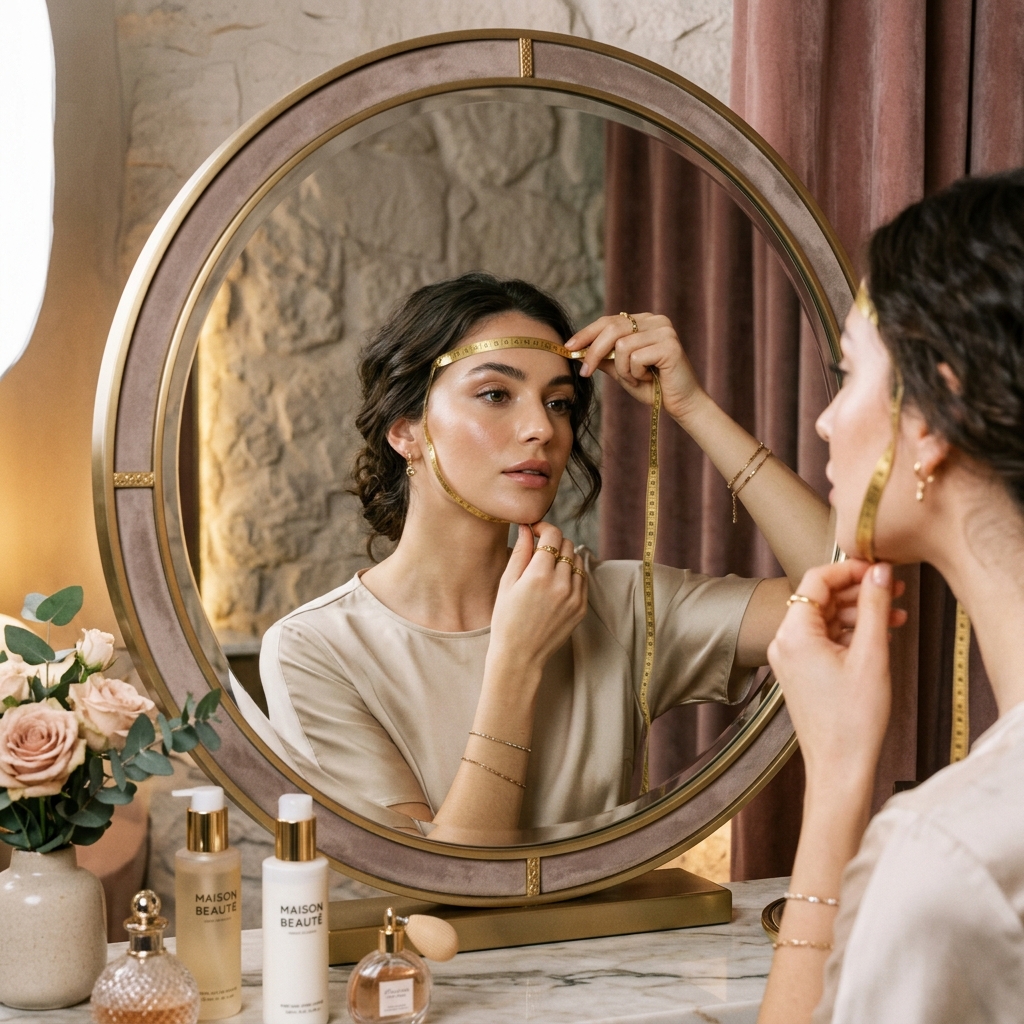
You've heard it a dozen times — "know your face shape" — but nobody ever explains exactly how. Do you measure? Use the mirror? Just look? And which method is actually accurate? This guide walks you through five proven methods to determine your face shape at home, from the quickest visual check to the most precise measurement technique. By the end, you'll know exactly what shape you're working with.
Identifying your face shape sounds like it should be simple. But stand in front of a mirror and try to label your own face as "oval" or "square" and you'll quickly realise it's not as obvious as it seems. Lighting affects what you see. Hair changes the apparent outline. And the categories themselves — while useful — aren't always obvious from a quick glance.
The good news is there are several reliable methods, and they're all easy to do at home with little or no equipment. We'll walk through all five — with step-by-step instructions, visual guides, and a clear explanation of how to interpret what you find. Let's get your face shape determined once and for all.
Why Knowing Your Face Shape Actually Matters
Before we get into the methods, let's briefly cover why determining your face shape is worth the few minutes it takes. Your face shape is the single most useful piece of information for making style decisions — because it's the fixed, unchanging foundation that every haircut, glasses frame, and makeup technique either works with or against.
- Haircuts: Your stylist uses your face shape to decide where to add or remove volume, how to frame your face, and what length will be most flattering
- Glasses: The contrast rule — choosing frames that contrast with your face shape — only works if you know what shape you're contrasting against
- Makeup & Contouring: Contour and highlight placement is entirely specific to your face shape — generic tutorials won't give you the best results
- Beard styles: For men, knowing your face shape tells you exactly which beard shape will complement your jaw and balance your proportions
Good News: You only need to determine your face shape once. Your bone structure doesn't change — so once you know your shape, you have that knowledge forever. It's a five-minute investment that pays off for a lifetime of better style decisions.
The 5 Methods at a Glance
Here's a quick overview of all five methods before we dive into each one in detail. Choose the approach that suits your situation best — or use two methods together to confirm your result.
Measurement Method
Use a flexible tape measure to record four key dimensions and compare the numbers to determine your exact face shape.
Mirror Trace Method
Trace the outline of your face directly on a mirror with a marker — then compare the shape to the seven face shape categories.
Photo Method
Take a front-facing photo with hair pulled back and compare your facial outline against reference shapes.
AI Detection
Upload a photo to an AI face shape detector for instant, data-driven analysis with high accuracy.
Ratio Method
Calculate the ratio between face length and width, and the relative widths at different zones, to categorise your shape mathematically.
Method 1: The Measurement Method — Most Accurate
The measurement method is the gold standard for determining your face shape at home. It removes guesswork entirely and gives you hard numbers to compare against clear criteria. You'll need a flexible tape measure (the kind used for sewing) or a piece of string that you can then measure against a ruler.
Step-by-Step: How to Take All 4 Measurements
- 1Prepare your face. Pull all your hair completely back — not just a ponytail, but every strand away from your face. Tie it back or use a headband. Any hair framing your face will distort your measurements.
- 2Measure your forehead width (F). Hold the tape across your forehead, parallel to the floor, at its widest point — this is usually about halfway between your hairline and your eyebrows. Record this number.
- 3Measure your cheekbone width (C). Place one end of the tape at the most prominent, pointy part of your cheekbone — found just below the outer corner of your eye — and measure across to the same spot on the other side. This is usually the widest point of your face. Record this number.
- 4Measure your jawline width (J). Place the tape at the tip of your chin and measure to the angle of your jaw — that's the corner where your jaw turns sharply upward toward your ear. Double this number to get your total jaw width. Record this number.
- 5Measure your face length (L). Place the tape at the centre of your hairline (the very middle of your forehead where your hair begins) and measure straight down to the tip of your chin. Record this number.
- 6Compare your measurements. Now take your four numbers (F, C, J, L) and use the interpretation table below to identify your face shape.
How to Interpret Your Measurements
| Face Shape | Widest Point | Length vs Width | Forehead vs Jaw | Key Clue |
|---|---|---|---|---|
| Oval | Cheekbones (C) | L > C (face is longer than wide) | F slightly > J | Balanced — no extremes in any direction |
| Round | Cheekbones (C) | L ≈ C (nearly equal) | F ≈ J | Width and length are very close to equal |
| Square | All similar (F ≈ C ≈ J) | L ≈ C or slightly > | F ≈ J (both broad) | Strong angular jaw with no significant taper |
| Heart | Forehead (F) | L > C | F significantly > J | Wide forehead, noticeably narrow jaw |
| Diamond | Cheekbones (C) | L > C | F ≈ J (both narrow) | C much wider than both F and J |
| Oblong | All similar (F ≈ C ≈ J) | L significantly > C | F ≈ J | Face is noticeably longer than wide, uniform width |
| Triangle | Jaw (J) | L > C | J significantly > F | Wide jaw, noticeably narrow forehead |
Important: If your measurements don't clearly match one category, look at which face shape is the closest match — most real faces sit between two categories. The shape with the most matching criteria is your face shape. You can also combine two shapes' styling tips for the most personalised approach.
Method 2: The Mirror Trace Method — No Tools Needed
The mirror trace method is the oldest trick in the book — and it works surprisingly well, especially for getting a clear visual sense of your face shape outline. All you need is a mirror, a bar of soap or a dry-erase marker, and good lighting.
- 1Set up your mirror. Stand in front of a large mirror with the best lighting you can find. Even lighting from the front (not above or below) gives the clearest outline. Bathroom mirrors with front-facing bulbs work perfectly.
- 2Pull your hair back completely. Use a tight headband or clip every strand away from your face. The trace is only accurate when your entire face outline — from hairline to chin — is clearly visible.
- 3Stand the right distance. Position yourself so your face fills most of the mirror — approximately 30–40cm away. Close one eye (this eliminates parallax — the slight distortion that comes from using both eyes to judge depth).
- 4Trace your face outline. Using a bar of soap, dry-erase marker, or lip liner, trace the outline of your face directly onto the mirror. Follow your hairline at the top, trace down both sides of your face (following your actual face width at each level), and end at the tip of your chin.
- 5Step back and look. Move back from the mirror and look at the shape you've drawn. What does it most closely resemble? Oval, round, square, heart, diamond, oblong, or triangle?
- 6Take a photo of the trace. Optional but useful — photograph your mirror with the trace visible and study it on your phone screen alongside reference images of each face shape.
Soap Tip: A wet bar of soap works better than a dry marker for the mirror trace — it's easier to see and wipes off cleanly. Use the edge of the bar for a finer line. Alternatively, lipstick or a whiteboard marker work well.
Method 3: The Photo Method — Quick & Visual
The photo method is probably the most widely used approach today, thanks to smartphones. It's fast, requires no tools, and gives you something you can study at leisure — comparing your face outline against reference images of each face shape category.
How to Take the Right Photo for Face Shape Analysis
- 1Hair completely back. Use a headband, wet your hair back, or clip it flat. Even subtle wisps at the temples can significantly alter the apparent face shape in a photo.
- 2Even, front-facing lighting. Natural daylight facing a window is ideal. Avoid overhead lighting (creates shadows under the jaw and chin that distort shape) and backlighting (makes the face a silhouette).
- 3Camera at eye level. Hold your phone at eye level — not slightly above (looking down) or below (looking up). Both angles distort your face shape. A slight chin-level angle specifically makes round faces look more oval.
- 4Neutral expression. Relax your face completely — no smiling, squinting, or raised eyebrows. A neutral expression gives the most natural, accurate representation of your face shape.
- 5Straight-on, no tilt. Keep your head perfectly level — no chin tilt up or down, no head tilt left or right. Chin tilts especially change how wide or narrow the jaw appears.
How to Analyse Your Photo
Once you have a well-taken photo, there are two approaches:
- Visual comparison: Open your photo alongside reference images of all 7 face shapes and compare the overall outline, the width of the forehead vs jaw, and the length-to-width ratio
- Digital trace: Use a photo editing app to draw over your hairline and face outline — then compare the drawn shape to the seven face shape silhouettes
- Overlay method: Print your photo and place it next to (or over) a printed chart of the seven face shapes to find the closest match
Method 4: AI Face Shape Detection — Fastest & Most Precise
AI-powered face shape detection is the fastest and — when used correctly — the most objectively accurate method for determining your face shape. It removes all human subjectivity from the equation and uses computer vision to analyse your facial geometry mathematically.
How AI Face Shape Detection Works
Modern AI face shape detectors use a multi-step process:
- 1Facial landmark detection. The AI identifies 68+ key points on your face — including the corners of your eyes, the edges of your lips, the tip of your nose, the curve of your jaw, and the outline of your chin. These landmarks are the raw data for all subsequent analysis.
- 2Geometric measurement. Using the landmark positions, the AI calculates precise measurements: forehead width, cheekbone width, jaw width, and face length — with sub-millimetre accuracy from the image data.
- 3Ratio analysis. The measurements are converted to ratios (length-to-width, forehead-to-jaw, cheekbones-to-forehead) and compared against the dimensional profiles of all seven face shapes.
- 4Shape classification. A machine learning model — trained on thousands of labelled faces — classifies your face shape and returns a confidence score. Advanced systems return percentages across all seven shapes, which is useful for faces that sit between categories.
Best Practices for AI Face Shape Detection
- Hair must be fully pulled back — this is the single most important factor for accuracy
- Use even, front-facing lighting — harsh shadows under the chin or jaw cause the AI to misclassify the jaw width
- Neutral expression — smiling changes the jaw width and cheek fullness significantly
- Camera at exact eye level — even a slight upward or downward angle changes the apparent proportions
- No filters or beauty modes — phone beauty modes often slim the face digitally, which will distort your face shape result
Method 5: The Ratio Method — Mathematical Precision
The ratio method takes your four measurements and converts them into ratios that reveal your face shape with mathematical clarity. This is essentially what the AI does under the hood — and it's useful to understand even if you're using AI, because it helps you make sense of your result.
The Two Key Ratios for Determining Face Shape
Ratio 1 — Length-to-Width (L:C): Divide your face length (L) by your cheekbone width (C).
- L:C between 1.0 and 1.3 → Likely round or square face
- L:C between 1.3 and 1.6 → Likely oval or heart face
- L:C above 1.6 → Likely oblong or diamond face
Ratio 2 — Forehead-to-Jaw (F:J): Divide your forehead width (F) by your jaw width (J).
- F:J well above 1.0 (F much wider) → Likely heart face
- F:J close to 1.0 (roughly equal) → Likely oval, round, or square face
- F:J well below 1.0 (J much wider) → Likely triangle face
Combine both ratios to narrow down your face shape. For example: L:C of 1.4 + F:J of 0.98 → oval (longer than wide, balanced forehead and jaw). L:C of 1.0 + F:J of 1.0 → round (equal dimensions throughout).
Reading Your Results: What Each Face Shape Looks Like
Once you've run through your chosen method, here's how to interpret what you see or measure. These visual cues are the clearest way to identify each face shape:
Longer than wide. Cheekbones widest. Gentle jaw taper. No extremes — everything looks balanced.
Most versatile — 95% of styles work
Width ≈ Length. Full cheeks. Soft jaw. The outline looks circular — minimal difference between all widths.
Goal: add length with vertical styles
F ≈ C ≈ J. Angular jaw. The jaw has a clear, squared-off corner. The outline looks boxy.
Goal: soften angles with curves
F > C > J. Wide forehead tapers to a narrow, pointed chin. Often has a widow's peak.
Goal: add volume at jaw level
C much > F and J. Striking wide cheekbones. Narrow forehead and chin. Longest of all face shapes.
Rarest shape — widen forehead & chin
L >> C. F ≈ C ≈ J. Very long and narrow. The face looks noticeably elongated with uniform width.
Goal: add horizontal width
J > C > F. Narrow forehead widens to broad cheekbones and an even wider jawline. Pear-shaped.
Goal: add crown volume
Common Mistakes When Determining Your Face Shape
These are the most frequent errors people make — any one of them can lead to an inaccurate face shape result:
- Not pulling hair back fully. This is the number one mistake. Even light wisps framing the face change the apparent outline dramatically. Pull every single strand back before any method.
- Using an angled photo. Even a small upward or downward tilt changes the apparent proportions of your face. Always use a perfectly straight-on, eye-level photo.
- Relying on one measurement alone. Looking only at your jaw shape or only at your forehead is insufficient. All four measurements together tell the complete story.
- Confusing oval and oblong. Both are longer than wide. The difference is that the oval has visible cheek curvature and a tapered jaw, while the oblong is more uniformly wide throughout with minimal curve.
- Ignoring that most faces fall between categories. If your measurements put you right on the border between two shapes, that's accurate — you're between two shapes. Combine the styling advice from both rather than forcing yourself into one box.
- Using bad lighting for photos or AI. Harsh overhead lighting casts shadows under the jaw and chin that make the face look significantly narrower at the bottom — causing misclassification toward a heart or diamond shape.
- Measuring on the skin with makeup. Contouring and highlighting change the apparent shape of your face visually. Remove makeup before attempting visual methods, or ensure your AI photo is taken before applying contour.
Comparing All 5 Methods: Which Is Best for You?
Each method has its strengths and weaknesses. Here's how they compare across the key factors that matter when you're trying to determine your face shape:
Measurement Method
Mirror Trace Method
Photo Method
AI Detection
Ratio Method
Best Combination
Our Recommended Approach
If you want the most reliable face shape determination, use this combination: start with the AI face shape detector for an instant baseline result, then take your four measurements manually to confirm. If both methods agree — which they will in the vast majority of cases — you have your answer with high confidence. If they disagree, check which measurement differs and consider whether your AI photo met all the requirements (hair back, eye level, even lighting, no filters).
Conclusion: You Now Know How to Determine Your Face Shape
There are five reliable methods — measurements, mirror trace, photo analysis, AI detection, and the ratio method. Each one works. The fastest is AI; the most precise is measurements; the combination of both gives you near-certain accuracy.
The most important preparation step for any method is the same: pull all your hair back. Everything else is secondary. Once you have a clear, unobstructed view of your face outline, any of these methods will give you an accurate face shape result.
Now that you know how to determine your face shape, explore our style guides — for haircuts, glasses, makeup, and beards — all tailored to your specific shape. Your best style decisions start with this one piece of knowledge.
Frequently Asked Questions
10 FAQsThe most accurate way to determine your face shape is to combine two methods: take all four manual measurements (forehead, cheekbones, jaw, and face length) and cross-reference with an AI face shape detector. When both methods agree — which they do in the vast majority of cases — you have a highly confident result.
Yes — a selfie can work well for the photo method or for AI face shape detection, but it needs to meet specific criteria: hair completely pulled back, camera held at exact eye level (not above looking down), even front-facing lighting, no beauty mode or filters, and a neutral expression. A self-timer and a phone propped at eye level often gives better results than a hand-held selfie.
The key difference: an oval face is noticeably longer than wide (roughly 1.4:1 ratio) with visible curvature at the cheeks and a gently tapered jaw. A round face has nearly equal width and length (close to 1:1 ratio) with full, rounded cheeks and minimal jaw taper. Measure your face length and cheekbone width — if they're nearly equal, you're round; if length is noticeably greater, you're likely oval.
Both have relatively uniform width from forehead to jaw. The difference is the jaw and the length. A square face has a strongly angular, clearly squared-off jaw and a length roughly equal to width. An oblong face has a less angular jaw and is noticeably longer than it is wide. Measure your face length and cheekbone width — if length is significantly greater (ratio above 1.5), you're more likely oblong.
This is very common — most real faces fall between two face shape categories. Don't try to force yourself into a single box. Identify the two shapes your measurements come closest to, then combine the styling advice from both. An AI face shape detector is particularly useful here because it returns confidence percentages across all seven shapes, showing you exactly where you sit in the spectrum.
The underlying bone structure that defines your face shape doesn't change. However, fat distribution on your face does change with weight fluctuations. Gaining weight can make a square face appear rounder; losing weight can make a round face appear more oval. For the most consistent result, measure yourself at a stable weight, and ensure the photo used for AI detection represents your typical appearance.
With the AI detection method, it takes less than 60 seconds once you have a suitable photo. The measurement method takes about 5–10 minutes to take all four measurements and compare them. The mirror trace method takes about 5 minutes. Using a combination of AI and measurements together — which gives the highest confidence — takes roughly 10–15 minutes total.
Yes — all five methods apply equally to men and women. The four measurements, the mirror trace, the photo method, AI detection, and the ratio method all work identically regardless of gender. The interpretation of results is also the same — the seven face shape categories apply universally. However, men's faces tend to have more angular features overall, which can sometimes make them sit closer to the square or oblong end of their measurements.
Several factors change how your face shape appears in photos: camera height (slightly above makes the face look narrower; slightly below makes it look wider), lighting (harsh overhead light shadows the jaw, making it appear narrower), lens distortion (wide-angle phone cameras distort faces, especially at close range), and facial expression (smiling changes jaw width and cheek fullness). For consistent results, always use the same standardised setup: eye-level camera, front-facing even light, neutral expression.
The Detect Face Shape AI tool at detect-faceshape.com is free, fast, and uses facial landmark detection to identify your face shape accurately. Upload a suitable photo (hair back, eye level, even lighting) and get your result in seconds with full style recommendations. For manual confirmation, all you need is a flexible tape measure — no additional tools or apps required.