Face Shapes: The Complete Guide
to All 7 Types
Everything you need to know about face shapes — how to identify yours, what defines each shape, and how to use it to make smarter style decisions for hair, glasses, makeup, and more.
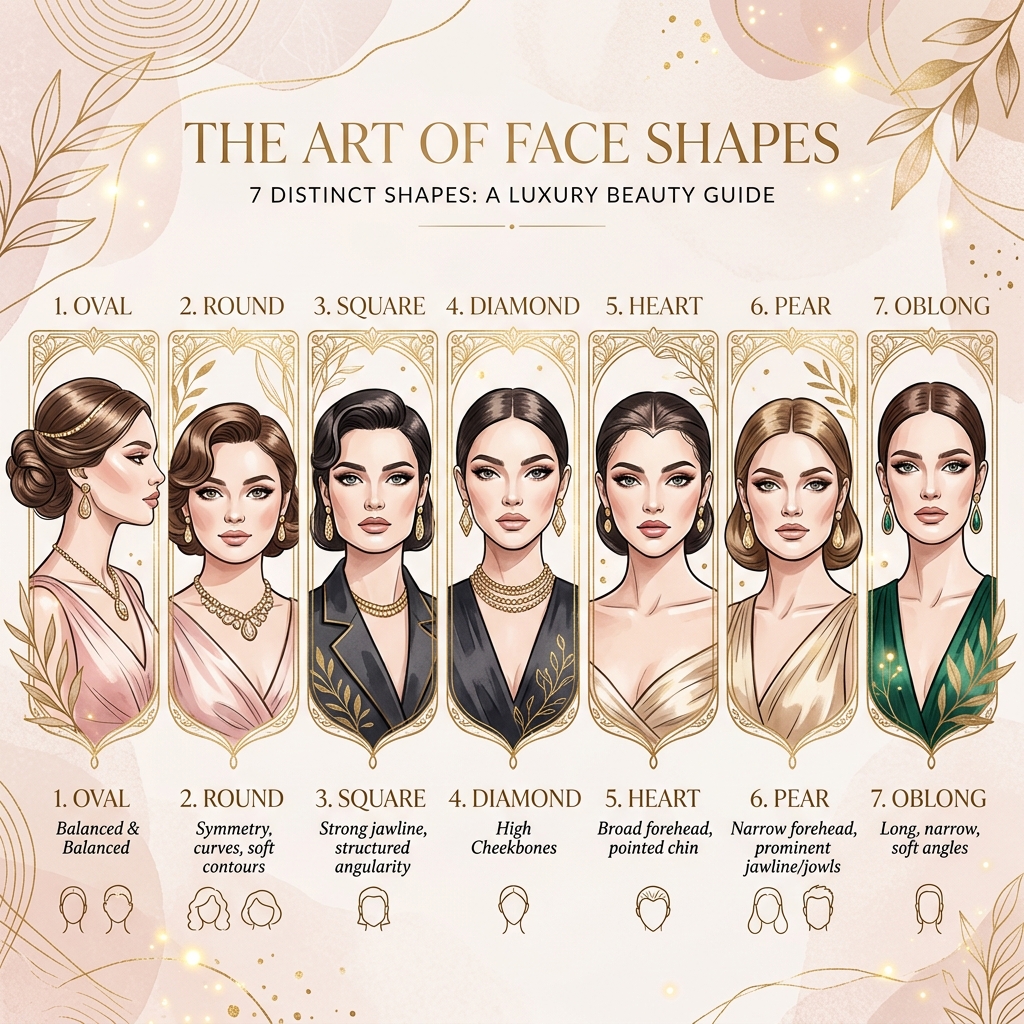
Explore All 7 Face Shapes
Tap any shape to see its key features, rarity, and top style tips
Your face shape is the single most important factor in almost every style decision you make — from the haircut you choose to the glasses frames you try on. Yet most people go through life never actually knowing which face shape they have. This guide changes that. We cover everything: what face shapes are, how to identify yours, and what each one means for your style.
What Are Face Shapes?
A face shape is the overall geometric silhouette formed by the outline of your face — defined by the width of your forehead, cheekbones, and jawline, and the length from hairline to chin. There are seven recognised primary face shapes: oval, round, square, heart, diamond, oblong, and triangle.
Your face shape is determined by your bone structure — the size and position of your skull, cheekbones, and jaw. Unlike your hairstyle or makeup, it doesn't change with seasons or trends. It's the permanent foundation beneath every style decision you make.
Understanding face shapes matters because the principles of visual balance apply universally. A well-chosen hairstyle can make a wide face appear slimmer or a long face appear shorter. Glasses frames chosen in contrast to your face shape create visual harmony. Makeup applied with your face shape in mind creates depth, definition, and proportion that generic tutorials simply can't achieve.
Fastest Method: Use our AI-powered face shape detector — upload a front-facing photo and get your face shape identified in seconds with detailed style recommendations tailored to your result.
How to Find Your Face Shape
There are three reliable methods for identifying your face shape: measurements, the mirror method, and AI detection. Here's how each works:
Method 1: The Four Measurements
Pull all your hair back so your entire face outline is visible, then measure:
- 1Forehead width: Measure across your forehead at its widest point — typically halfway between your hairline and eyebrows, parallel to the floor.
- 2Cheekbone width: Measure from the outer corner of one eye straight across to the same point on the other side — usually the widest point of your face.
- 3Jawline width: Measure from the tip of your chin to the angle of your jaw (where it turns upward toward your ear) and double that number.
- 4Face length: Measure from the centre of your hairline straight down to the tip of your chin.
Method 2: The Mirror Trace
Stand close to a mirror, pull all your hair back, and use a dry-erase marker or soap to trace your face outline directly onto the glass. Step back and compare the shape to the seven face shape categories below.
Method 3: AI Face Shape Detection
AI face shape detectors use facial landmark detection to analyse the measurements and proportions of your face from a single photo, delivering your face shape result in seconds with impressive accuracy.
The 7 Face Shapes: An Overview
Here are all seven face shapes — their defining characteristics, styling goals, and what makes each one unique.
Slightly longer than wide, gently rounded jaw, balanced proportions. Every hairstyle and glasses frame works beautifully.
Equal width and length, full cheeks, soft curved jawline. Add length with tall hairstyles and angular glasses.
Broad forehead, strong angular jaw, equal widths. Soften with waves, layers, and round glasses frames.
Wide forehead and cheekbones tapering to a narrow, pointed chin. Balance with jaw-level volume and rimless glasses.
Narrow forehead and chin with dramatically wide, high cheekbones. Add width at forehead with curtain bangs and cat-eye frames.
Noticeably longer than wide with uniform width. Add horizontal width with blunt bangs, waves, and oversized glasses.
Narrow forehead widening to broad cheekbones and jaw. Add crown volume and use bold top-heavy glasses frames.
1. Oval Face Shape
The oval face shape is characterised by a face slightly longer than wide, with gently rounded edges, a softly tapered jaw, and cheekbones as the widest point. The forehead is slightly wider than the jaw, and both taper gently toward their ends. Widely considered the most balanced and versatile of all face shapes.
Key Features
- Face length greater than width (roughly 1.5:1 ratio)
- Cheekbones are the widest point
- Forehead slightly wider than jawline
- Jawline softly rounded, not angular
Styling Tips for Oval Faces
- Hairstyles: Any cut, length, or texture — pixie, bob, long layers, blunt cuts, curtain bangs
- Glasses: Any frame shape — rectangular, round, cat-eye, aviator, oversized
- Makeup: Light contouring along the temples; any makeup style works
- Beard (men): Any beard length or shape works naturally
2. Round Face Shape
The round face shape has nearly equal width and length, with full rounded cheeks and a soft curved jawline. No sharp angles — the outline is consistently curved. People with round faces often appear younger than their age due to full cheeks.
Key Features
- Face width and length nearly equal — looks circular
- Full, rounded cheeks are the defining visual feature
- Soft, curved jawline — not angular
- Forehead and jaw similar in width
Styling Tips for Round Faces
- Hairstyles: Long layers, side-swept bangs, high buns, lobs — add vertical height
- Glasses: Rectangular, square, or geometric frames add angular definition
- Makeup: Contour sides; highlight centre forehead and chin to elongate
- Avoid: Chin-length blunt bobs, full blunt bangs, flat short crops
3. Square Face Shape
The square face shape features a broad forehead, prominent cheekbones, and a strong angular jawline — all roughly equal in width. The defining characteristic is the squared-off jaw, which gives this shape a powerful, structured appearance that photographs exceptionally well.
Key Features
- Forehead, cheekbones, and jaw all similar in width
- Angular, strong, squared-off jawline is the defining feature
- Face length roughly equal to or slightly greater than width
- Overall silhouette appears boxy or rectangular
Styling Tips for Square Faces
- Hairstyles: Soft waves, long layers, side parts, curtain bangs — add curves
- Glasses: Round, oval, or rimless frames contrast with the angular jaw
- Makeup: Contour jaw corners and forehead corners; highlight centre
- Avoid: Jaw-length blunt bobs, slicked-back styles, square frames
4. Heart Face Shape
The heart face shape — also called the inverted triangle — has a wide forehead and prominent cheekbones tapering to a narrow, often pointed chin. Many people with heart-shaped faces also have a widow's peak hairline. The goal is to balance the wide top with the narrow bottom.
Key Features
- Forehead is the widest point
- Cheekbones are prominent and high
- Chin is narrow and often pointed
- Widow's peak is commonly present
Styling Tips for Heart Faces
- Hairstyles: Chin-length bobs, side-swept bangs, lobs with volume at ends
- Glasses: Bottom-heavy frames, rimless styles, light-coloured top frames
- Makeup: Contour the wide forehead; highlight chin to add visual width
- Avoid: High updos, heavy blunt bangs, cat-eye frames
5. Diamond Face Shape
The diamond face shape is the rarest — defined by a narrow forehead, dramatically wide and high cheekbones (the widest point), and a narrow chin. The overall outline creates a sharp, angular diamond silhouette that is highly photogenic and coveted in modelling.
Key Features
- Cheekbones are dramatically wide — the widest point
- Forehead is narrow — noticeably narrower than cheekbones
- Chin is narrow and often pointed
- Face is longer than wide
Styling Tips for Diamond Faces
- Hairstyles: Curtain bangs, side-swept bangs, chin-length bobs, volume at crown
- Glasses: Cat-eye, oval, browline frames — all add width to narrow forehead
- Makeup: Highlight forehead and chin; contour cheekbones softly
- Avoid: Volume at cheekbones, centre-parted flat styles, slicked-back looks
6. Oblong Face Shape
The oblong face shape — also called the long face or rectangle face — is noticeably longer than wide, with relatively uniform width from forehead to jaw. Unlike the oval face, the oblong lacks significant cheek curvature and appears more uniform in width throughout.
Key Features
- Face length significantly greater than width
- Forehead, cheekbones, and jaw all similar in width
- Lacks the curved taper of an oval face
- Overall silhouette appears long and rectangular
Styling Tips for Oblong Faces
- Hairstyles: Blunt bangs, waves and curls, shoulder-length with side volume
- Glasses: Oversized frames, wide frames, decorative temples
- Makeup: Horizontal highlight across cheekbones; contour forehead and chin
- Avoid: Very long straight styles, high updos, narrow frames
7. Triangle Face Shape
The triangle face shape — also called the pear-shaped face — is the inverse of the heart shape. It features a narrow forehead that widens progressively to broad cheekbones and an even wider jawline. The silhouette creates a triangular or pear-like outline.
Key Features
- Jawline is the widest point of the face
- Forehead is noticeably narrower than the jaw
- Face widens progressively from hairline to jaw
- Overall silhouette forms a triangle or pear shape
Styling Tips for Triangle Faces
- Hairstyles: Crown volume, pixie with full top, side-swept bangs, A-line bobs
- Glasses: Bold top-heavy frames, aviators, cat-eye, browline frames
- Makeup: Highlight forehead and temples; contour along the jaw
- Avoid: Volume at jaw and cheeks, flipped-out ends, flat slicked-down tops
Complete Face Shape Comparison Table
| Face Shape | Widest Point | Key Feature | Hair Goal | Best Glasses | Rarity |
|---|---|---|---|---|---|
| Oval | Cheekbones | Balanced, longer than wide | Any style — total freedom | Any frame shape | Most common |
| Round | Cheekbones | Equal width & length, full cheeks | Add vertical height | Rectangle, square | Very common |
| Square | Jaw (equal to forehead) | Angular, strong jawline | Soften angles with curves | Round, oval, rimless | Common |
| Heart | Forehead | Wide forehead, narrow pointed chin | Add volume at jaw level | Bottom-heavy, rimless | Common |
| Diamond | Cheekbones | Narrow forehead & chin, wide cheeks | Widen forehead & chin | Cat-eye, oval, browline | Rarest |
| Oblong | Uniform width | Long & narrow, rectangular | Add horizontal width | Oversized, wide frames | Less common |
| Triangle | Jaw | Narrow forehead, wide jaw | Add crown volume & top width | Top-heavy, aviator, cat-eye | Less common |
How to Use Your Face Shape for Better Style Decisions
Knowing your face shape is the first step. Applying it is where the real transformation happens.
Face Shape and Hairstyles
Your face shape determines the most flattering hairstyle length, texture, and structure. The core principle: use your hairstyle to visually balance your face shape's natural proportions. Add height for wide faces, add width for long faces, add softness for angular faces, and add structure for soft faces.
Face Shape and Glasses Frames
Choose glasses frames that contrast your face shape. Angular face shapes (square, triangle) suit rounded frames. Soft, round face shapes suit angular frames. The contrast creates visual balance across your entire face.
Face Shape and Makeup Contouring
Contour and highlight placement should be tailored to your face shape. Darker contour recedes areas you want to minimise; lighter highlight advances areas you want to emphasise. The goal is always to visually suggest a balanced, proportional oval face shape.
Face Shape and Beard Styles
Beard styles work like hairstyles for the lower face — they can add or remove apparent width and length from the jaw and chin. Round face men benefit from beards with length at the chin to elongate. Square face men suit rounded beard styles that soften the jaw. Oval face men can wear any beard style confidently.
Best AI Results: For the most accurate AI face shape detection, use a front-facing photo with your hair pulled back, even lighting with no harsh shadows, a neutral expression, and your face centred in the frame.
Conclusion: Know Your Face Shape, Know Your Style
Your face shape is the foundation of every style decision you make. Whether you have an oval, round, square, heart, diamond, oblong, or triangle face — understanding your face shape means you can make every haircut, glasses choice, and makeup decision with genuine confidence rather than guesswork.
Every face shape has its own unique beauty and its own set of style opportunities. The goal was never to make your face look like an oval — the goal is to understand and celebrate the face shape you have, and to use that knowledge to make choices that make you look and feel your absolute best.
Ready to discover yours? Use our AI-powered face shape detector for an instant, accurate result — then explore our detailed style guides for hair, glasses, makeup, and more tailored to your specific face shape.
Frequently Asked Questions About Face Shapes
10 FAQsBeauty professionals generally recognise seven primary face shapes: oval, round, square, heart, diamond, oblong, and triangle. Real human faces rarely fit perfectly into one category — most people have a primary face shape with characteristics of a secondary shape. Some systems recognise additional variations like pear (triangle) or rectangle (oblong).
The oval face shape and round face shape are the most common globally, with oval typically cited as the most prevalent. The diamond face shape is generally considered the rarest — characterised by dramatically wide cheekbones with a narrow forehead and chin.
Attractiveness is highly subjective and varies significantly across cultures and individuals. The oval face shape is often called the 'ideal' in style guides because it imposes the fewest styling limitations — not because it is objectively more beautiful. Every face shape has its own unique aesthetic qualities.
Your underlying bone structure — which defines your face shape — does not change significantly after growth stops. However, changes in weight, ageing, and skin laxity can alter how your face shape appears. A square face may look slightly rounder with weight gain; a round face may appear more oval with weight loss.
Both are longer than wide, which is why they're often confused. The oval face shape has visible curvature at the cheeks and a gently tapered jaw. The oblong face shape is notably more elongated, has more uniform width from forehead to jaw, and lacks the pronounced cheek curvature. If your face looks unusually long and narrow, you're likely oblong rather than oval.
Both have a narrow chin, but their top halves differ significantly. The heart face shape has its widest point at the forehead — the whole upper half is wide. The diamond face shape has a narrow forehead, with the widest point being the dramatically prominent cheekbones in the mid-face. If your forehead is noticeably narrow, you're diamond; if your forehead is wide, you're heart.
This is extremely common — most real faces sit between two face shape categories. Identify your two closest shapes and combine the styling recommendations from both. An AI face shape detector can give you a confidence percentage across all seven shapes, helping you understand your unique blend.
The seven face shape categories apply equally to men and women. However, men statistically have more angular face shapes (square, oblong) due to higher bone density and jaw prominence from testosterone. Women more commonly present with oval, heart, and round face shapes on average.
The oval face shape is described as 'ideal' in style guides because most haircut and makeup techniques were historically developed with oval proportions as the baseline — not because oval faces are objectively more attractive. A square face's strong jaw, a diamond face's striking cheekbones, or a heart face's elegant taper are all genuinely beautiful characteristics.
Modern AI face shape detectors achieve 85–95% accuracy for well-lit, front-facing photos with hair pulled back. Performance varies with lighting quality, hair obscuring the face outline, or unusual angles. For the most accurate result, use a neutral-expression, evenly lit, straight-on photo with all hair pulled back from the face.